Precise X-Y-Z Readout with a micro-Magnetometer Inverted-pyramid Design (PYRAMID)
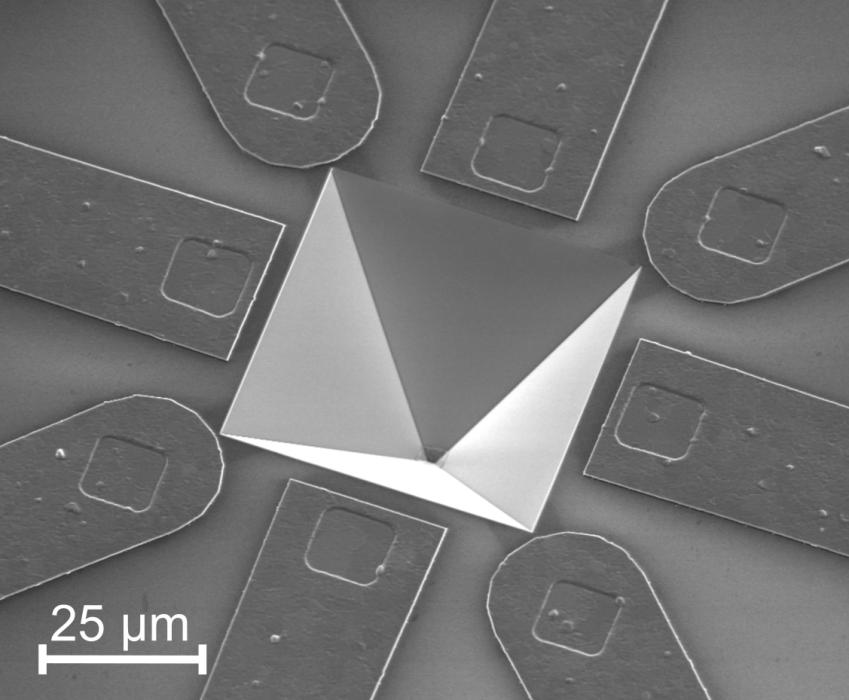
Chip-scale magnetometers come in several flavors, the most common being silicon Hall-effect plates that integrate easily with electronics. However, these devices only detect 1D fields, are asymmetric between X-Y and Z directions, and cannot work in extreme temperatures. The project goal was to leverage my expertise in micromachining and wide-bandgap semiconductor Hall-plates to realize magnetometers with a unique "3D" microstructure that uses 10% of the space of existing "3x1D" sensors, and is 3-10x more accurate. This enables new products for 3D navigation in autonomous microsystems such as biomedical implants, power monitoring, and nanosatellites.
This project involved the development of the inverted pyramid device through crystallographic etching of <100> CMOS silicon to expose the <111> crystal plane at 54.7°. This enables higher angular accuracy and avoids fabrication misalignment or packaging errors. The <111> crystal plane of silicon also supports direct GaN and other 3D Material integration with CMOS chips. In parallel, the host group, the Electronics Instrumentation(EI) laboratory at TU Delft, was to develope a CMOS integrated circuit for front-end amplification and switching scheme of the sensor to detect all three components of the field from a singular device.
Project data
| Researchers: | |
|---|---|
| Starting date: | September 2023 |
| Closing date: | March 2026 |
| Funding: | 203 kE; related to group 203 kE |
| Contact: | Karen Dowling |